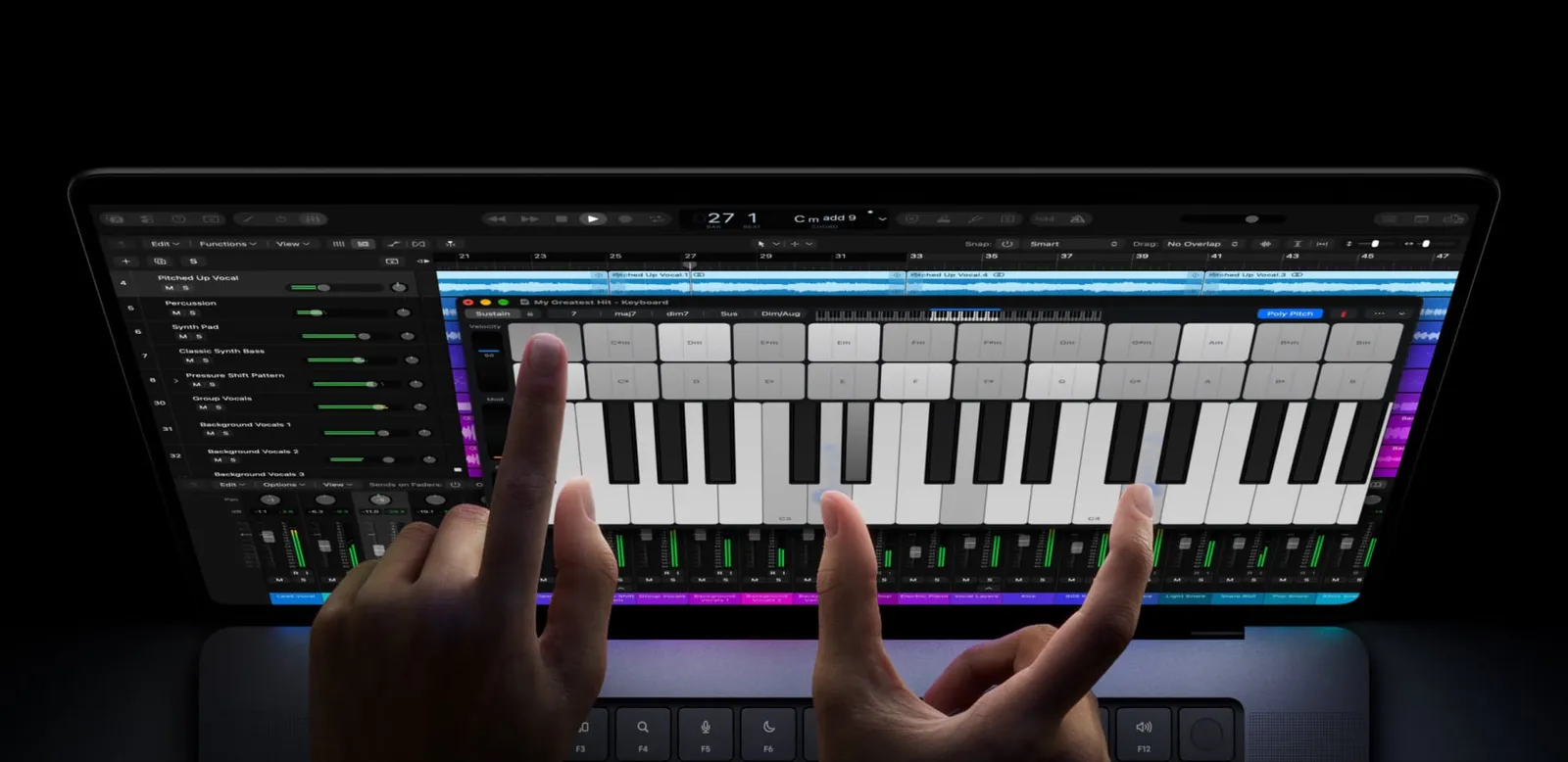
Jobs said "It doesn't work": now Apple is selling a touchscreen MacBook Pro
October 20, 2010. At Apple's "Back to the Mac" event, the company is explaining which ideas Mac is borrowing from iOS. The question is already hanging in the air: if the iPhone and iPad are used with a finger, why can't we touch a Mac's screen? Steve Jobs's answer was short and clear:
"We've done tons of user testing on this, and it turns out it doesn't work. Touch surfaces don't want to be vertical. It gives great demo but after a short period of time, you start to fatigue and after an extended period of time, your arm wants to fall off. It doesn't work, it's ergonomically terrible."
He went on to say that touch surfaces want to be horizontal, and pointed to the solution: the multi-touch trackpads Apple had been refining for years. The Magic Mouse and Magic Trackpad were products of the same logic. The message was clear: Mac has multi-touch, but not on the screen — under your hand.
16 years later: the same company, the opposite product
On October 28, 2026, Apple introduced the new MacBook Pro with a dual-layer ("tandem") OLED display it calls "PROLED XDR". In the company's own words, touch comes to the Mac for the first time. It comes in 14- and 16-inch sizes, powered by an M5 Pro or M5 Max chip. Pre-orders opened on announcement day, and devices start shipping and arriving in stores on November 6.
In Türkiye, the 14-inch model with M5 Pro starts at 199,999 TL and the 16-inch at 234,999 TL. The M5 Max models start at 314,999 TL for the 14-inch and 332,999 TL for the 16-inch.
The touch experience Apple describes is a familiar one: scrolling a page, pinching a photo to zoom, double-tapping a window to make it full screen, dragging and dropping items. The touch sensor is built into the display panel itself, not layered on top; Apple says this reduces latency. Designers will be able to use the whole screen as a canvas without being limited by the trackpad, musicians will be able to play software instruments on the screen, and developers will be able to try the touch behavior of their iOS and iPadOS apps directly on the Mac.
Does it answer Jobs's objection?
To be honest, I didn't see a direct answer to the "arm fatigue" issue in Apple's announcement. But a few clues stand out:
- The hinge has been redesigned; Apple says it aims to keep the screen steadier when you use touch.
- Touch arrives alongside the keyboard and trackpad, not instead of them. Apple stresses that the new methods work together with keyboard shortcuts and trackpad gestures.
- There is also a video stabilization feature that reduces camera shake when you touch the screen during video calls. So Apple has taken into account that the screen can move while being touched.
One more note: Jobs's 2010 statement wasn't saying "touchscreens are bad." He was saying that constantly reaching out to a vertical laptop screen isn't practical. Apple's approach today also offers touch as an additional option rather than making it the primary way of working. So saying "Apple completely changed its mind" would be a hasty take. A better reading might be this: a generation of users who grew up with the iPad instinctively point at the screen on a Mac too, and Apple no longer ignores that habit.
The real question: will it work in real life?
It's an impressive product on paper. But the real test will happen on real desks, where people work for hours every day. How many times a day will your finger go to the screen? Or will you end up going back to the trackpad after a while? Was Jobs's concern in 2010 right, or is the device itself good enough to solve it? Only users will show that, once sales begin.
What I find interesting is this: in the tech world, things declared "never" don't tend to stay that way for long. An idea flatly rejected in 2010 shows up in 2026 as the most talked-about feature of Apple's new MacBook Pro. To see which side turns out to be right, waiting until November 6 is enough.