Nemotron 3.5: Bringing agent intelligence from data centers to desktops
The important question in the agent market is no longer only which model is smarter. It is also where the model can run and under which data boundaries. The Nemotron 3.5 family approaches that question from both ends: high-volume visual and tool use for data centers, and smaller local models for desktops and edge devices. That creates a more practical deployment map than using one enormous model for every job.
Announced on October 15, Nemotron 3.5 Super VL is described as an open 120-billion-parameter model. It targets instruction following, tool use, multistep workflows and visual understanding, with the goal of approaching the accuracy of a much larger reasoning model. The announcement claims up to five times faster throughput than other models in its class; that figure should be treated as a vendor claim tied to particular tests and hardware. Open weights, datasets and training recipes may matter more than the headline speed because they give organizations a path to adapt the model to their own data.
The same announcement introduces two Bolt models. The 74B-A9B version uses native two-bit quantization to target local agent tasks within 24 GB of memory. The E4B version is aimed at conversational and physical-agent scenarios in a four-gigabyte memory class, with availability stated for October 23. The result is a pitch for running web research, coding or document work locally instead of sending it to the cloud.
Local execution offers more than privacy. An organization can more directly control which data the model can access, what happens when the system is offline and how customization is maintained. The tradeoff is that hardware capacity, updates, model security and observability become the organization’s responsibility. Open weights do not automatically make a system safe or cheap, and fine-tuning on internal data does not guarantee quality.
I would start by selecting one repetitive workflow and comparing local and cloud execution with the same measures: latency, correction time, energy, data leaving the system and total cost of ownership. Nemotron 3.5’s promise is to distribute agent intelligence across hardware tiers. The decision should follow those measurements on real work, rather than the most impressive model demo.
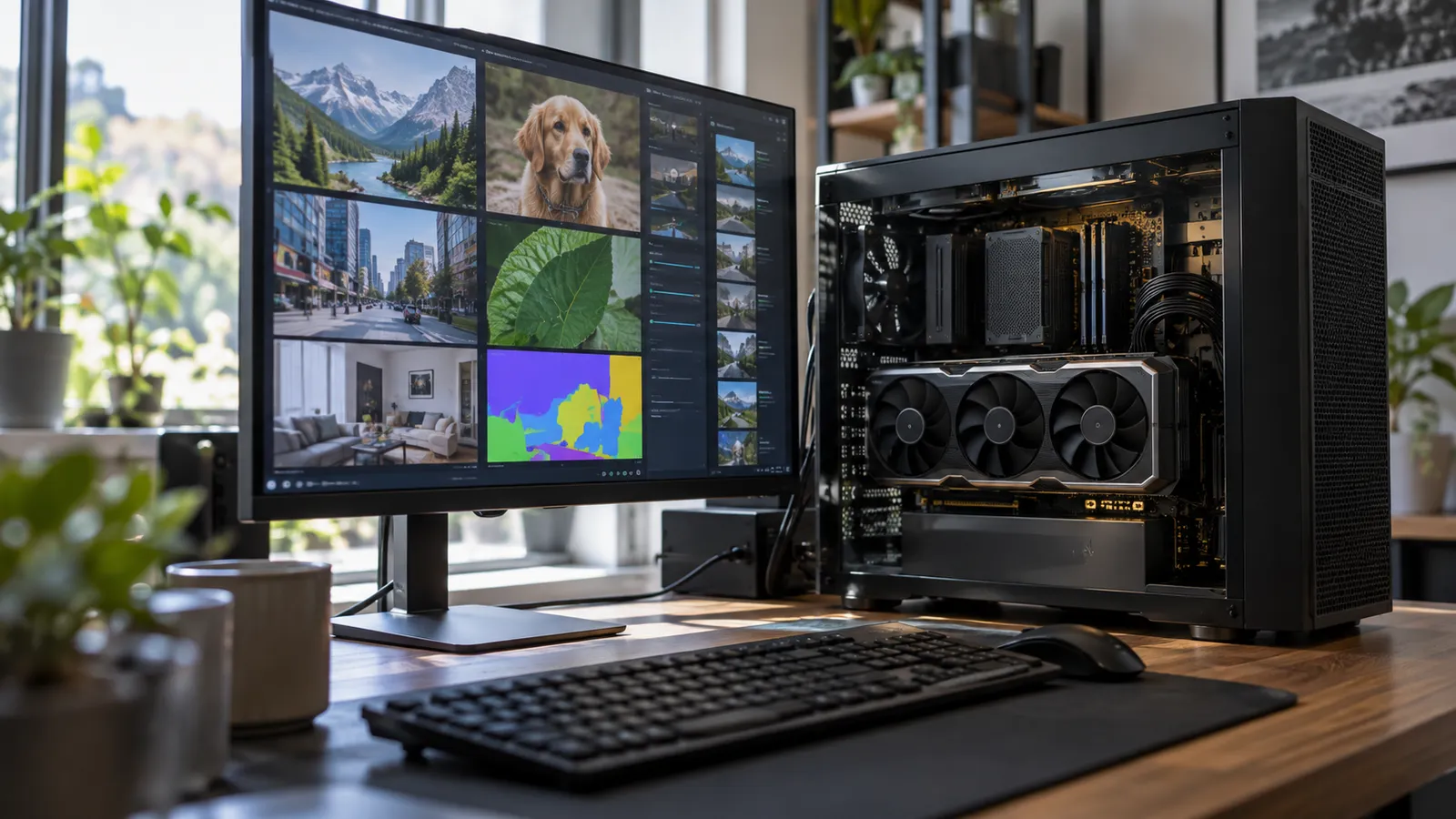
The cover is an AI-generated illustrative scene, not an authenticated product or event photograph.