MLX and RDMA: A Mac Studio cluster for large-model inference
Running large language models locally has often been defined by the memory limit of one powerful machine. The newer approach is to split a model across several computers and run them together over a fast interconnect. MLX support for distributed inference over RDMA shows how desktop-class systems can scale without depending exclusively on specialized clusters. It does not mean everyone will run trillion-parameter models at home, but it expands the options for local AI.
A technical study dated October 15 describes MLX using unified memory on Apple silicon and supporting a move from one Mac Studio to multiple machines. As an example, it examines Muse Spark Open, a model with roughly 816 billion parameters. On four M5 Ultra Mac Studio systems, the setup generated more than 36 tokens per second. That result needs to be read together with the model version, quantization, context length and benchmark command used.
The key infrastructure change is low-latency RDMA over Thunderbolt 5. MLX 0.30.1 and later uses communication collectives called jaccl for different parallelization schemes. Pipeline parallelization divides the model across layers; tensor parallelization divides each layer’s width across machines. The former is simpler and can improve prefill for some long-context workloads. The latter performs more small communication operations, so it is more sensitive to network latency, but it can improve generation speed as machines are added.
The practical implication is that an organization can consider several local machines instead of one data-center system, while network and memory planning become part of the job. The study reports up to a 4.6-times improvement in time to first token for M5 Ultra over M3 Ultra and a 1.6-times increase in generation speed. It also reports peak consumption of about 300 watts for M5 Ultra. Those values should be measured again with the actual model, context and electricity cost before a purchase decision.
I would first test such a cluster with private research and coding workflows. The baseline on one machine, communication overhead and total energy use should all be recorded. MLX’s progress matters because it changes the local-inference question from whether a model fits to how many machines can run it efficiently, and at what communication cost.
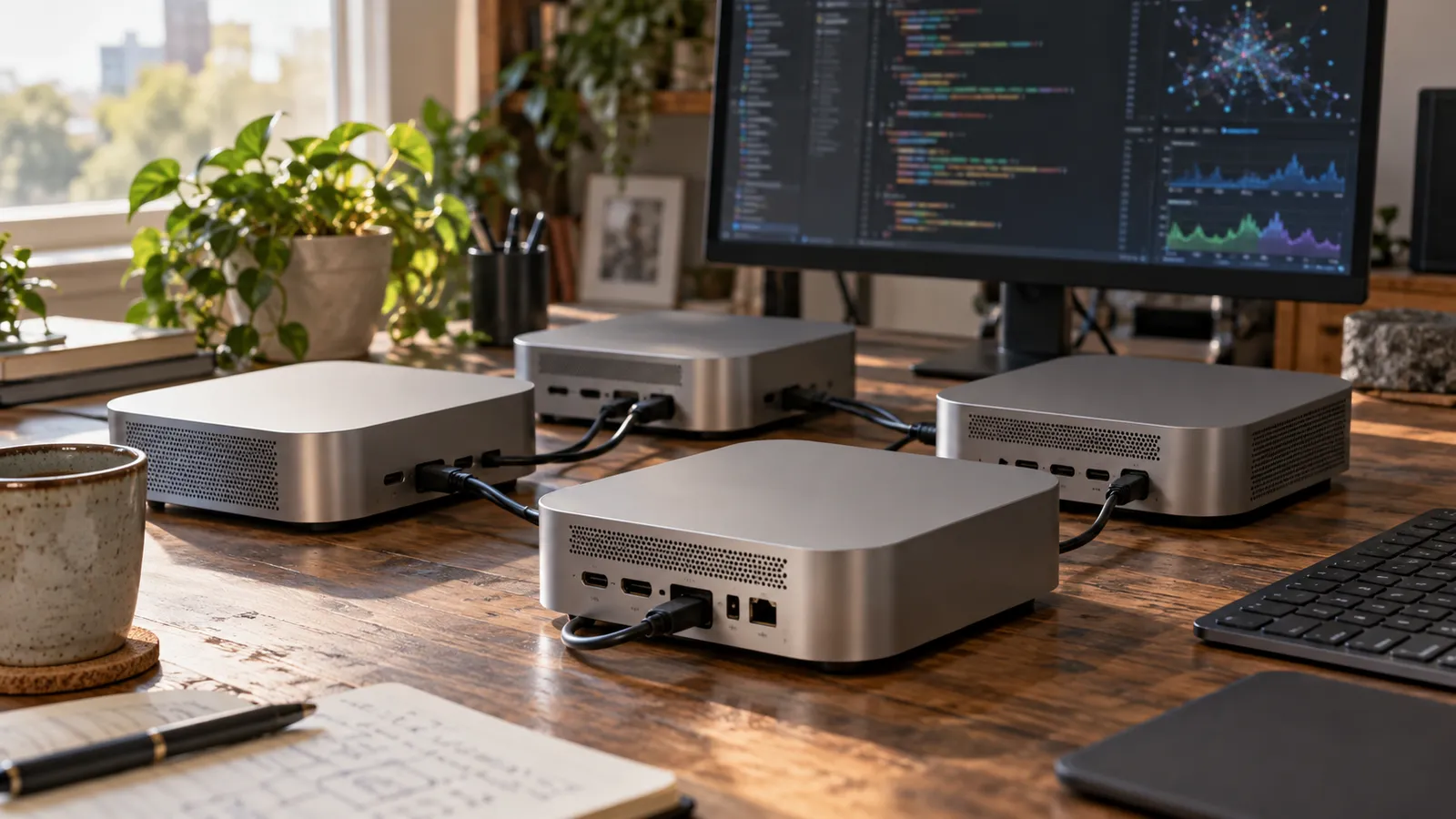
The cover is an AI-generated illustrative scene, not an authenticated product or event photograph.