Google reduces a costly quantum computing bottleneck on its Willow processor
Google Quantum AI says it has demonstrated magic state cultivation on real hardware using its Willow processor. Useful quantum computing beyond classical machines depends on high-quality error-corrected states known as magic states. Producing them can consume a large share of a quantum computer’s resources; the research team cites estimates in which up to 95% of capacity could be devoted to this task. Every resource spent there leaves less room for useful computation.
The method injects a noisy quantum state into a small region, then uses coordinated measurements to remove flawed attempts. A cleaner state can be grown into a larger encoding. Google reports that its protocol reduced errors by about 40 times compared with uncultivated states on Willow, and achieved 99.99% logical fidelity for T-states. Those figures describe a particular experiment and do not mean that a general-purpose fault-tolerant quantum computer is ready.
The team found that laboratory noise from electrical equipment drift and temperature variation was interfering with measurements. It added system controls and developed a benchmarking technique that uses cultivation itself as a measurement tool. This matters because quantum progress depends on hardware engineering, calibration, and measurement science as much as on algorithms.
The researchers also tested transferring states between a distance-three color code and a distance-five surface code. That is an encouraging signal that different error-correction approaches can be connected within one architecture. Important questions remain: whether the protocol scales, whether errors stay low during longer computations, and whether resource savings hold in useful applications. This is an experimental answer to one bottleneck, rather than a claim that quantum advantage is complete.
The phrase practical solution therefore needs a narrow reading. Magic-state production is only one obstacle: qubit quality, connectivity, control electronics, and stable error-correction cycles also have to scale. Experimental fidelity may change in longer circuits or different algorithms. The work is still valuable because it turns a theoretical proposal into measurable engineering steps on hardware, even though commercial expectations would be premature.
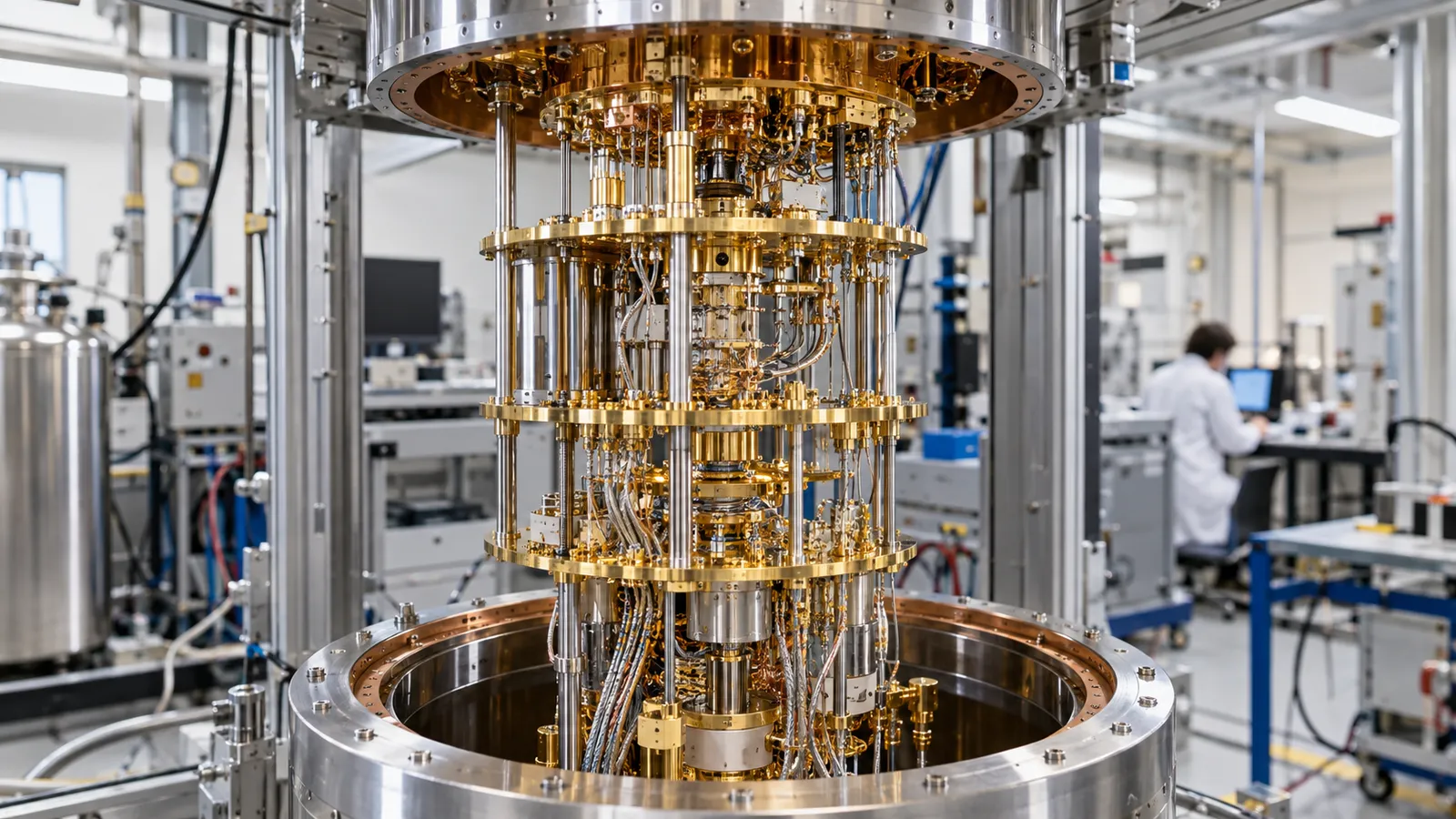
The cover is an AI-generated illustrative scene, not an authenticated product or event photograph.