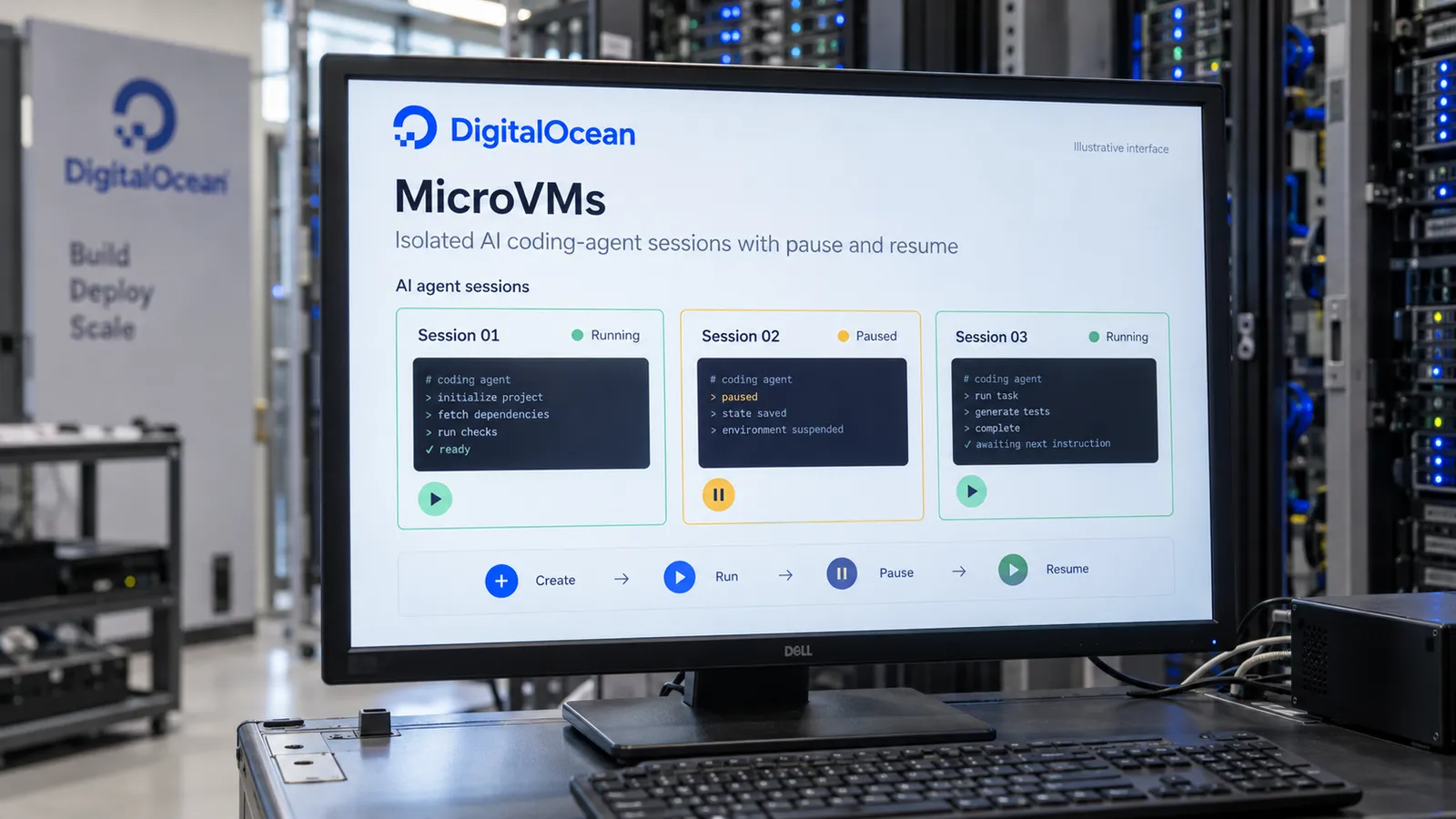
DigitalOcean MicroVMs: the cost of waiting for AI agents
When discussing the cost of AI agents, we usually focus on a model’s token prices. But a coding agent does more than generate answers: it installs packages, runs tests, and changes files. How we start and stop the environment where those actions happen also shapes a product’s economics.
DigitalOcean’s MicroVMs, launched in public preview on October 9, addresses this second layer. Built on Firecracker, the service runs container images in virtual machines, each with its own kernel. What I find valuable is the possibility of making a separate workspace for every agent session a natural part of the application.
Waiting does not have to mean losing the environment
A coding agent’s work is not continuous. The user reviews an output, requests changes, or switches to something else. Deleting the workspace between these steps requires setting it up again; keeping it running continuously can create unnecessary costs.
Pausing a MicroVM preserves memory, files, and process state. Resuming lets the session continue where it left off; execution stops while it is paused. By default, automatic pausing happens after five minutes without traffic. An idle CPU and a paused environment should therefore not be treated as the same thing.
DigitalOcean describes startup and resume times in milliseconds. I would not treat that as a result measured in my own application: what matters to the user is the total time between sending a request and receiving a usable response.
Repeating the same setup may be unnecessary
Checkpoints let you create new workspaces from the memory and disk state of a prepared environment. A starting point with dependencies already installed can reduce repetitive setup work.
For me, the practical benefit is a more predictable experience. Instead of making users wait through the same installation steps every session, the development team can deliberately design which preparation is shared and which data belongs to an individual session.
Savings are about more than processor prices
As of October 11, 2026, an environment with two vCPUs and four GiB of memory costs $0.078 per hour while running. Keeping it in the running state for fifteen minutes produces a compute charge of $0.0195. That is not the total cost of the agent.
CPU and memory charges stop when the environment is paused; storage charges continue. Checkpoint storage, outbound data transfer, and the model API used also belong in the overall calculation. Measuring savings only by asking how many minutes were spent doing work would therefore be incomplete.
My first step would be a small pilot
The service is still in public preview and is not recommended for production workloads. It is currently available only in the MKC1 region, with linux/amd64 images.
Under these conditions, I would first try an agent workflow with long waits and short bursts of work. I would measure resume latency, file preservation, how pausing affects background jobs, and the actual bill together.
What interests me about MicroVMs is the way it puts the agent session’s lifecycle at the center of the infrastructure. The value of this approach will emerge in products that manage the workspace as carefully as the model.
The cover is an AI-generated illustrative image, not a screenshot of the actual product interface.